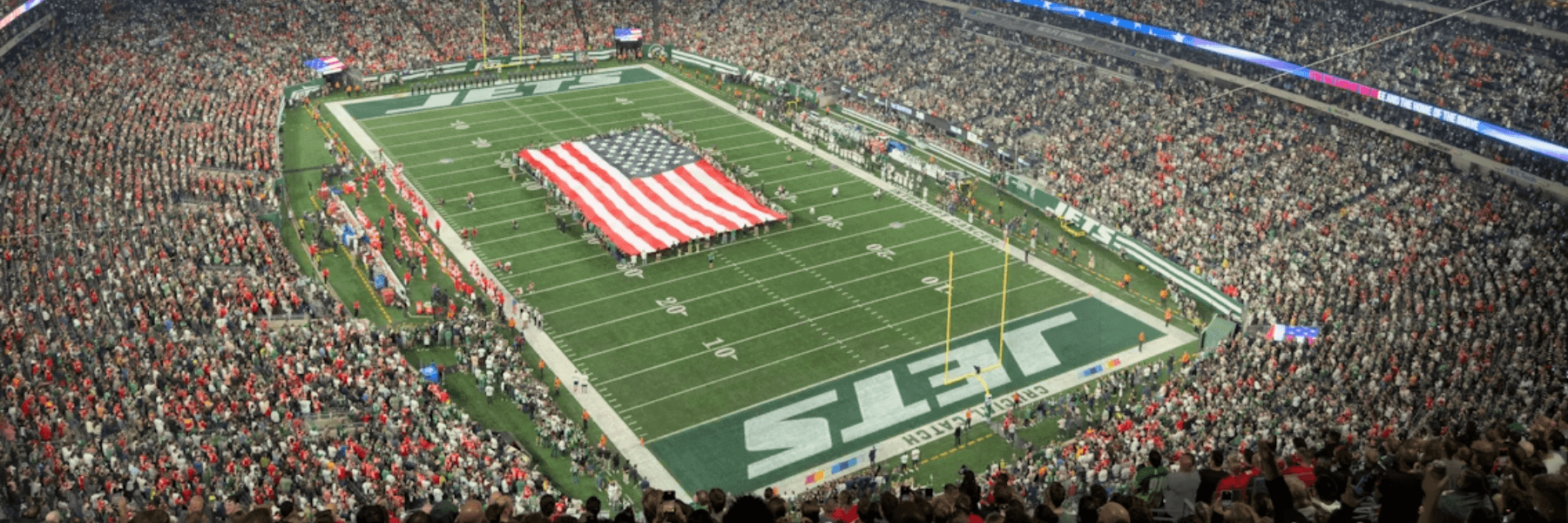











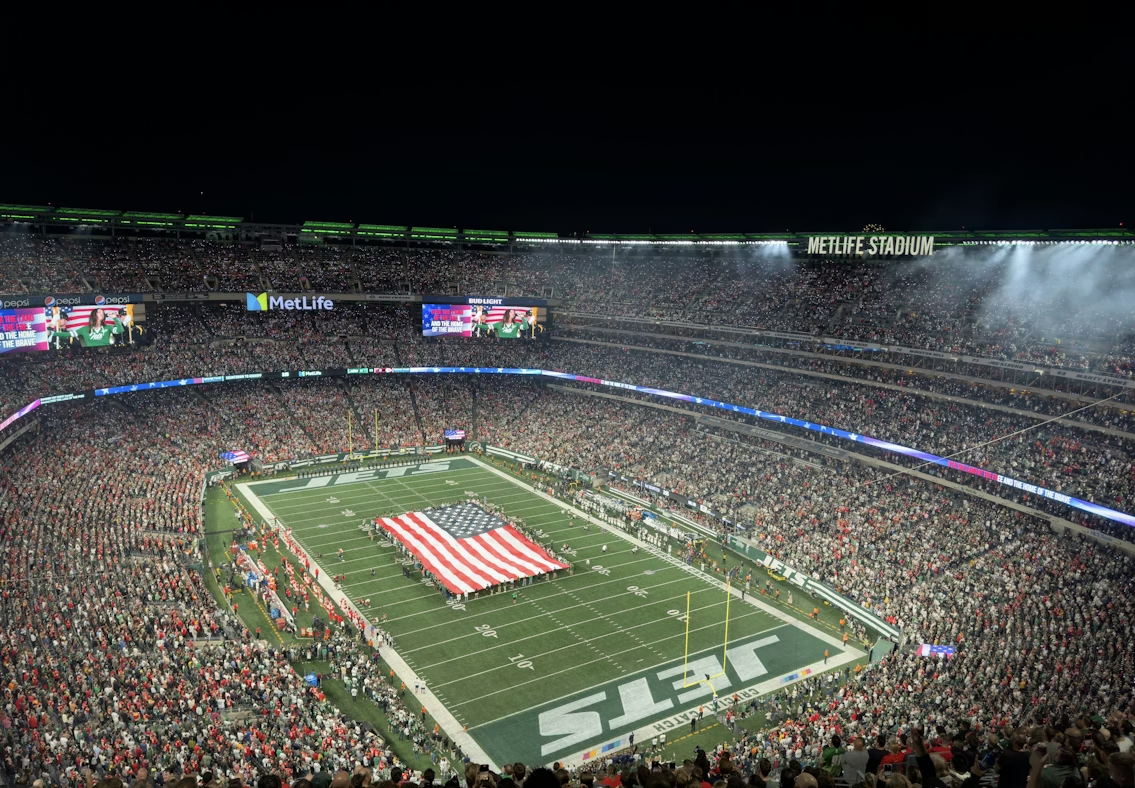
MetLife Stadium, home of the Jets - Source: Unsplash
Picture Aaron Rodgers right now—42 years old, enjoying his offseason, "talking to Mike, talking to Omar," not rushing a single damn thing. No contract offer on the table. No deadline. Just a veteran playing the most elaborate game of chicken while Omar Khan's roster planning bleeds out in real time.
Meanwhile, in the Big Apple, the Jets just welcomed home the ghost of Geno Smith—the same Geno Smith who threw 17 interceptions last season for the worst team in football, now repackaged as a bridge option at $3.3 million because Las Vegas ate the rest. Jerry Jones spent February promising to "bust the budget" and delivered Jalen Thompson. Four days into free agency, the chaos sorted itself: Baltimore stole Trey Hendrickson at four years, $112 million, and suddenly re-emerged as a genuine Lombardi contender after last season's playoff miss.
Online betting sites certainly seem to agree. The early Bovada NFL odds for next season position the Ravens as a +1100 fourth favorite to leave SoFi Stadium as champions next February, down from +1400 pre-Hendrickson. But while the future is looking brighter at M&T Bank Stadium, others still have plenty of work to do if they are to compete next term.
Jets
The Geno Smith trade is either the most pragmatic bridge move of the offseason or a slow-motion organizational implosion—and honestly, it might be both. Thirteen years after the Jets drafted him 39th overall, Geno is back, making $19.5 million total while going 12-18 as a starter the first time around and leading the NFL in interceptions last year. That's your bridge. No franchise quarterback, a receiver room that needs surgery, an offensive line with legitimate questions, and Nahshon Wright—the league's leading takeaway artist—signed for a ridiculous $5.5 million, which is genuinely shrewd and also does nothing about the fact that this offense needs a quarterback who doesn't hemorrhage the football.
Here's where it gets interesting: Kyler Murray is sitting out there at near-veteran-minimum cost because Arizona owes him $36.8 million in dead cap regardless of where he plays. That's essentially free money with All-Pro upside—a former No. 1 overall pick motivated by something to prove. Anthony Richardson from Indianapolis—declining his fifth-year option costs a second-round pick, offers a legitimate dual-threat ceiling—is the reclamation project worth gambling on if Murray lands elsewhere? Surely both offer more than Smith?
And then there's the draft. Fernando Mendoza, Indiana's consensus QB1, will be going to Las Vegas unless someone stumps up a three-first-round-pick trade package to snag him. That's the nuclear option. But Ty Simpson on Day 2 may also offer some upside, perhaps taking over as a starter midway through his rookie year, just as Jaxson Dart did across the Big Apple last term. 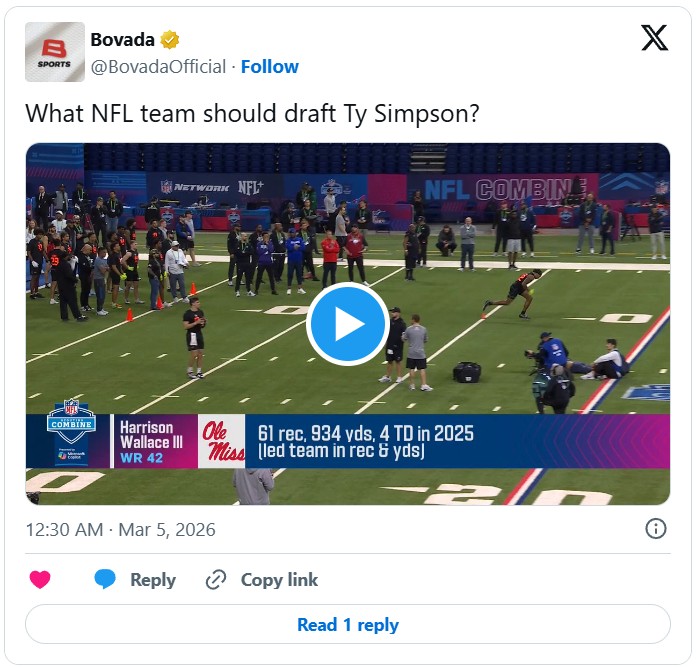
Vikings
The fall happened fast. Brutally fast. J.J. McCarthy's rough 2025 exposed Minnesota's quarterback fragility. Then Jonathan Allen departed. Then Javon Hargrave. The interior defensive line—the beating heart of any Kevin O'Connell defense—evaporated inside 72 hours, gutted so completely it nearly qualifies as malpractice. The Vikings went from legitimate NFC contender projections to genuine rebuild conversation in the same week that half the league was partying over their new contracts.
Minnesota is visiting Kyler Murray in the coming days, and the logic is sound; O'Connell engineered Sam Darnold's resurrection in 2024, and Murray's near-minimum cost carries negligible cap risk. Kirk Cousins is still unsigned, offering the sad-homecoming familiarity option nobody really wants, but everyone might settle for. On the trenches front, Joey Bosa—the best available edge rusher post-Hendrickson—fills one void; a Bradley Chubb trade from Miami at third-round cost addresses another. One offseason from irrelevance isn't hyperbole when your interior defensive line is a memory.
Commanders
Give Dan Quinn credit: Washington has been relentlessly busy. Rachaad White in the backfield. Chig Okonkwo at tight end. Nick Cross at safety. K'Lavon Chaisson and Charles Omenihu adding pass rush depth. Real moves. Legitimate upgrades. And yet—dead last in defensive yards allowed last season, 27th in scoring, and the secondary remains a patchwork construction project dressed up as an NFL roster. Volume shopping only works when you're filling the right holes.
The Commanders need a CB1 with genuine coverage credentials. Alontae Taylor—projected at four years, $77 million—transforms that secondary from sieve to functional. Bobby Wagner knows the system; a prove-it deal makes roster sense and costs almost nothing. Keon Coleman from Buffalo at Day 3 pick cost gives Jayden Daniels another weapon alongside Terry McLaurin. And Ohio State's Sonny Styles—safety/linebacker hybrid, third on Daniel Jeremiah's big board—could become the draft's most valuable selection for this specific roster. Quinn's blueprint is visible. The execution is halfway there. But halfway there doesn't win in the NFC East.
Cowboys
Jerry Jones spent an entire February promising to transform the league's worst defense—bottom of the NFL in yards and points—into something resembling competence under new defensive coordinator Christian Parker. "Bust the budget," he said, repeatedly, with the particular conviction of a man who genuinely believes his own rhetoric. Then he signed Jalen Thompson and traded Osa Odighizuwa and Solomon Thomas for eight draft picks, which is clever roster surgery and also leaves Parker's defense needing edge rushers, cornerbacks, linebackers, and safeties simultaneously.
Eight draft picks are ammunition. It's also a hedge—the kind of move that looks like a plan when it might just be a delay. Joey Bosa is available. Alontae Taylor is available. Nakobe Dean logged 128 tackles last season and fits any modern scheme. Bradley Chubb costs a second-round pick from Miami. Dak Prescott's prime has an expiration date that the calendar is actively approaching, and Parker can't defend anyone with practice-squad personnel and draft projections.
Cowboys fans have heard the promises. Now comes the part where Jones actually delivers—or doesn't